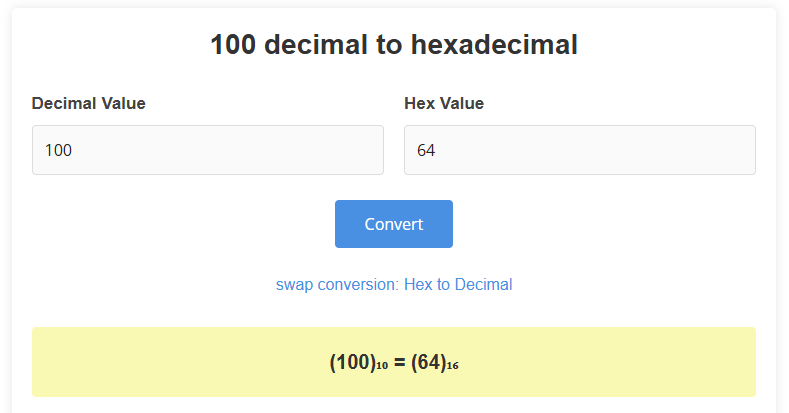
100 Decimal to Hexadecimal Converter
Converting 100 Decimal to Hexadecimal
The decimal number 100 is converted to hexadecimal by repeatedly dividing by 16 and recording the remainders. Let’s walk through this specific conversion:
Step-by-step conversion of 100 decimal to hexadecimal:
100 ÷ 16 = 6 remainder 4
6 ÷ 16 = 0 remainder 6
Reading remainders in reverse order: 64
Therefore, 100 in decimal = 64 in hexadecimal
Understanding the Result
The hexadecimal representation of 100 decimal is 64. In the hexadecimal system:
- The first digit (6) represents 6 × 16¹ = 6 × 16 = 96
- The second digit (4) represents 4 × 16⁰ = 4 × 1 = 4
- Adding them together: 96 + 4 = 100
This confirms that 64₁₆ is indeed equal to 100₁₀.
Why This Conversion Matters
Converting decimal to hexadecimal is particularly useful in computing. The number 100 in decimal might represent:
- A percentage value in programming (100%)
- A memory offset or address
- A value in a calculation or algorithm
- A color component in certain color models
When working with these values in programming or debugging, it’s often more convenient to view them in hexadecimal format.
Decimal to Hexadecimal Conversion Chart
This reference chart shows 100 decimal and its hexadecimal equivalent along with nearby values:
| Decimal | Hexadecimal | Decimal | Hexadecimal |
|---|---|---|---|
| 88 | 58 | 96 | 60 |
| 92 | 5C | 100 | 64 |
| 96 | 60 | 104 | 68 |
| 100 | 64 | 108 | 6C |
| 104 | 68 | 112 | 70 |
| 108 | 6C | 116 | 74 |
| 112 | 70 | 120 | 78 |
Common Applications of 100 Decimal (64 Hex)
In computing, the value 100 decimal (64 hex) might appear in various contexts:
- ASCII code: The character ‘d’ has ASCII code 100
- Percentages: 100% is represented as 100 in decimal calculations
- Arrays and loops: Often used as a loop counter or array size
- Network protocols: Port numbers or packet sizes
Quick conversion tips:
- To convert from decimal to hex, repeatedly divide by 16 and record remainders
- To convert from hex to decimal, multiply each digit by 16^position and sum
- Remember that hex A-F represent decimal values 10-15
- One byte (8 bits) is represented by two hex digits (00-FF)
Related
Frequently Asked Questions (FAQs)
What is 100 in hexadecimal?
100 in decimal is equal to 64 in hexadecimal.
How do you convert 100 decimal to hexadecimal?
To convert 100 from decimal to hexadecimal, divide the number repeatedly by 16 and note the remainders. Read the remainders from bottom to top to get the final hexadecimal value.
What is the formula to convert decimal to hexadecimal?
There is no single formula. The conversion is done using the repeated division by 16 method, where remainders form the hexadecimal digits.
Is 64 the correct hexadecimal value for 100?
Yes, 64 is the correct hexadecimal equivalent of 100 decimal. The conversion follows standard base-10 to base-16 rules.
What does base-16 mean in hexadecimal?
Base-16 means the number system uses 16 symbols (0–9 and A–F), where A represents 10 and F represents 15.