Gaining Ratio Calculator
3 : 2 (Partner A : Partner B)
Calculation Breakdown
How the fractions were resolved to find the exact gaining and sacrificing ratios.
| Partner | Old Fraction | New Fraction | Gain / (Sacrifice) |
|---|
What is the Gaining Ratio in Partnership Accounting?
In partnership accounting, whenever the structure of a business changes—most commonly when a partner retires, dies, or when profit-sharing terms are simply renegotiated—the remaining partners usually acquire the share of the outgoing partner. The proportion in which the continuing partners acquire this share is known as the Gaining Ratio.
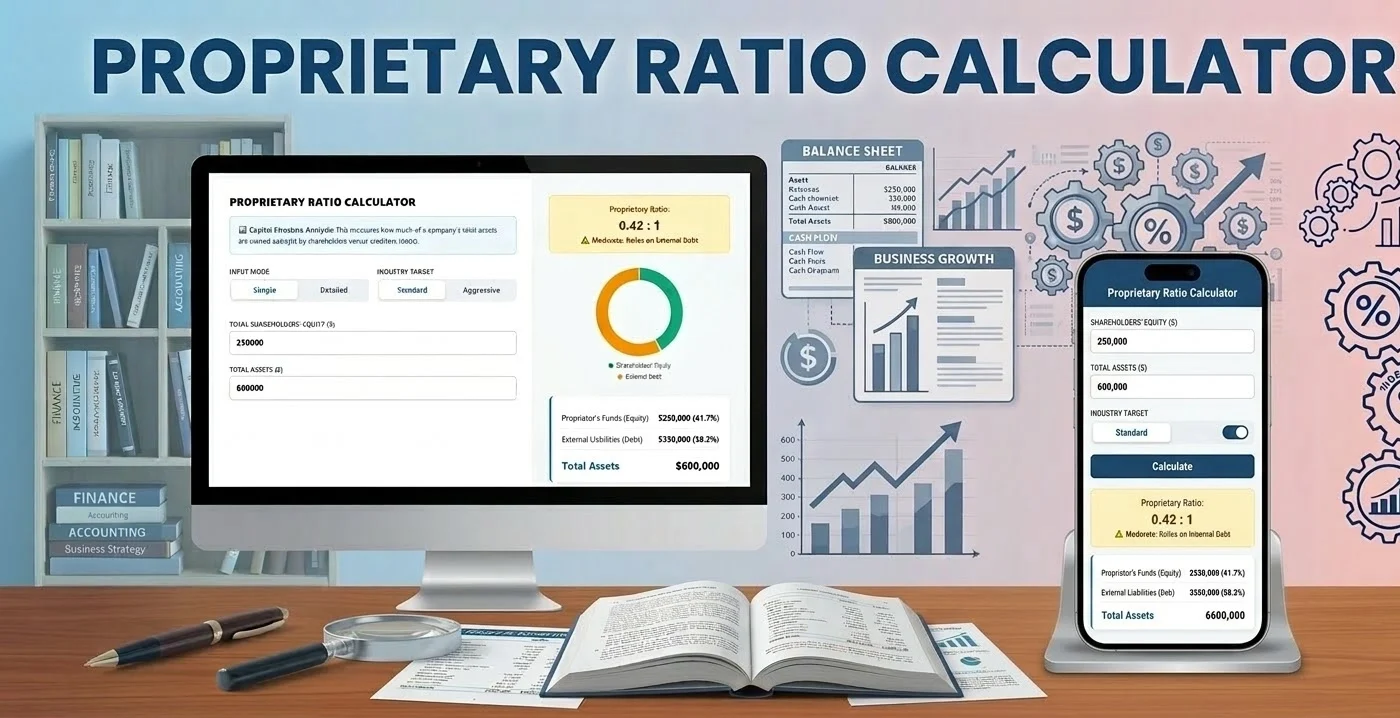
Calculating this ratio is absolutely critical because it dictates how the remaining partners will compensate the outgoing partner (or their estate) for their share of the firm’s Goodwill. Understanding how shares shift internally is just as crucial as understanding how your business balances its external debts, which you can analyze further using our Proprietary Ratio Calculator.
The Gaining Ratio Formula
The formula for calculating the gaining ratio for an individual partner is straightforward:
- If the result is Positive, the partner has gained a share.
- If the result is Negative, the partner has sacrificed a share.
- If the result is Zero, the partner’s share remains entirely unchanged.
Step-by-Step Calculation Example
Let’s walk through a real-world example to see how the mathematics work behind the scenes in our calculator.
Assume we have three partners: Alex, Ben, and Charlie. They share profits in the ratio of 5 : 3 : 2. Charlie decides to retire. Alex and Ben decide their new profit-sharing ratio will be 3 : 2.
Step 1: Determine the Old Fractions
First, add the old ratio numbers together to find the denominator (5 + 3 + 2 = 10).
- Alex’s Old Share = 5/10
- Ben’s Old Share = 3/10
- Charlie’s Old Share = 2/10
Step 2: Determine the New Fractions
Add the new ratio numbers together for the continuing partners (3 + 2 = 5).
- Alex’s New Share = 3/5
- Ben’s New Share = 2/5
- Charlie’s New Share = 0 (Retired)
Step 3: Apply the Formula
Subtract the old share from the new share for the remaining partners.
Gain = (3/5) – (5/10)
Gain = (6/10) – (5/10) = 1/10
Gain = (2/5) – (3/10)
Gain = (4/10) – (3/10) = 1/10
Result: Since Alex gained 1/10 and Ben gained 1/10, their gaining ratio between each other is 1:1. They will share the burden of compensating Charlie for his Goodwill equally.
Gaining Ratio vs. Sacrificing Ratio: What’s the Difference?
While they are mathematically opposite sides of the same coin, they are used in completely different accounting scenarios:
- Gaining Ratio is calculated during the retirement or death of a partner. It determines how continuing partners will pay Goodwill to the outgoing partner.
- Sacrificing Ratio is calculated during the admission of a new partner. It determines how the existing partners will surrender a portion of their profits to the newcomer, and how the new partner’s premium for Goodwill will be distributed among the old partners.
Frequently Asked Questions (FAQs)
When is the Gaining Ratio calculated?
It is calculated when a partner retires, when a partner passes away, or when the existing partners simply agree to change their mutual profit-sharing ratios.
What happens if the New Ratio is not given in a retirement problem?
If the partnership agreement is silent and no new ratio is provided, it is legally assumed that the continuing partners will acquire the retiring partner’s share in their old profit-sharing ratio. For example, if A, B, and C share 3:2:1 and C retires, A and B will continue sharing at 3:2.
Can a continuing partner have a sacrificing ratio?
Yes! Sometimes the new agreed-upon ratios are structured in a way where a continuing partner actually ends up with a smaller share than before. In this case, their calculation will result in a negative number, meaning they sacrificed alongside the retiring partner, and they too must be compensated for Goodwill.