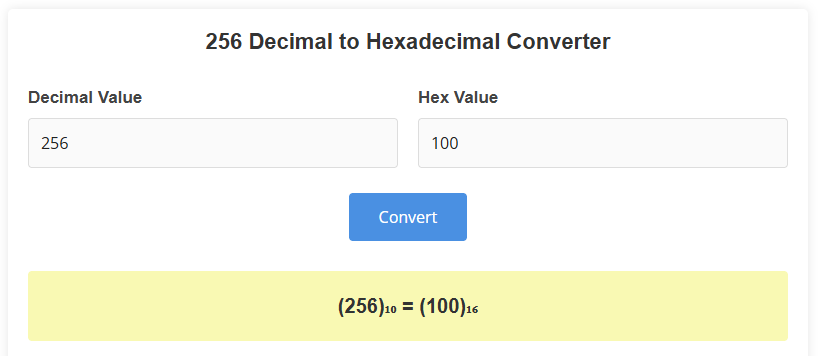
256 Decimal to Hexadecimal Converter
256 Decimal to Hexadecimal Converter
Converting numbers between different number systems is an important concept in mathematics and computer science. In this article, you will learn how to convert 256 from decimal to hexadecimal, along with a clear explanation, step-by-step method, and the final result.

What Is the Decimal Number System?
The decimal number system is a base-10 system that uses digits from 0 to 9. It is the most commonly used number system in everyday calculations.
Example:
- 256 (decimal)
= (2 × 10²) + (5 × 10¹) + (6 × 10⁰)
What Is the Hexadecimal Number System?
The hexadecimal number system is a base-16 system. It uses:
- Digits: 0–9
- Letters: A–F
Where:
- A = 10
- B = 11
- C = 12
- D = 13
- E = 14
- F = 15
Hexadecimal is widely used in programming, computer memory, networking, and digital systems because it represents large binary values in a compact form.
Formula to Convert Decimal to Hexadecimal
There is no single mathematical formula. Instead, conversion is done using the repeated division by 16 method:
- Divide the decimal number by 16
- Write down the remainder
- Divide the quotient again by 16
- Repeat until the quotient becomes 0
- Read the remainders from bottom to top
Step-by-Step Conversion of 256 Decimal to Hexadecimal
Let’s convert 256 (base-10) into hexadecimal.
Step 1: Divide by 16
256 ÷ 16 = 16
Remainder = 0
Step 2: Divide again
16 ÷ 16 = 1
Remainder = 0
Step 3: Divide again
1 ÷ 16 = 0
Remainder = 1
Step 4: Write remainders from bottom to top
Remainders: 1 0 0
Final Answer
(256)10=(100)16
✅ 256 decimal equals 100 in hexadecimal
Why Does 256 Become 100 in Hexadecimal?
- 256 is equal to 16²
- In base-16, this shifts the number two places to the left
- That is why the hexadecimal representation is 100
This is similar to how 100 in decimal represents 10².
Decimal to Hexadecimal Conversion Table (0–256)
| Decimal | Hexadecimal | Decimal | Hexadecimal |
|---|---|---|---|
| 0 | 0 | 32 | 20 |
| 1 | 1 | 33 | 21 |
| 2 | 2 | 34 | 22 |
| 3 | 3 | 35 | 23 |
| 4 | 4 | 36 | 24 |
| 5 | 5 | 37 | 25 |
| 6 | 6 | 38 | 26 |
| 7 | 7 | 39 | 27 |
| 8 | 8 | 40 | 28 |
| 9 | 9 | 41 | 29 |
| 10 | A | 42 | 2A |
| 11 | B | 43 | 2B |
| 12 | C | 44 | 2C |
| 13 | D | 45 | 2D |
| 14 | E | 46 | 2E |
| 15 | F | 47 | 2F |
| 16 | 10 | 48 | 30 |
| 17 | 11 | 49 | 31 |
| 18 | 12 | 50 | 32 |
| 19 | 13 | 51 | 33 |
| 20 | 14 | 52 | 34 |
| 21 | 15 | 53 | 35 |
| 22 | 16 | 54 | 36 |
| 23 | 17 | 55 | 37 |
| 24 | 18 | 56 | 38 |
| 25 | 19 | 57 | 39 |
| 26 | 1A | 58 | 3A |
| 27 | 1B | 59 | 3B |
| 28 | 1C | 60 | 3C |
| 29 | 1D | 61 | 3D |
| 30 | 1E | 62 | 3E |
| 31 | 1F | 63 | 3F |
Key Decimal → Hex Values (Commonly Used)
| Decimal | Hexadecimal |
|---|---|
| 64 | 40 |
| 80 | 50 |
| 96 | 60 |
| 112 | 70 |
| 128 | 80 |
| 144 | 90 |
| 160 | A0 |
| 176 | B0 |
| 192 | C0 |
| 208 | D0 |
| 224 | E0 |
| 240 | F0 |
| 255 | FF |
| 256 | 100 |
Why Use a 256 Decimal to Hexadecimal Converter?
A decimal to hexadecimal converter helps you:
- Save time
- Avoid manual calculation errors
- Get instant and accurate results
- Understand number system conversions easily
It is useful for students, programmers, engineers, and computer science learners.
Summary
- Decimal system uses base-10
- Hexadecimal system uses base-16
- Conversion is done by repeated division by 16
- 256 decimal = 100 hexadecimal
- Online converters make conversions quick and error-free