16 Decimal to Hexadecimal Converter
16 Decimal to Hexadecimal Converter
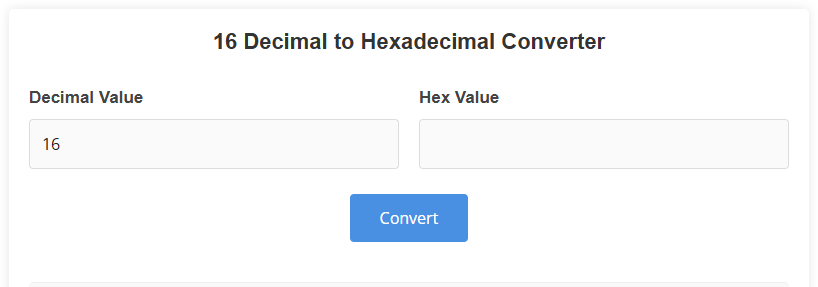
The 16 Decimal to Hexadecimal Converter is used to convert the decimal number 16 (base-10) into its hexadecimal equivalent (base-16). This is one of the most important and basic conversions in computer science, programming, and digital systems.
here, you’ll see:
- What decimal and hexadecimal number systems are
- How to convert 16 from decimal to hexadecimal step by step
- Why 16 plays a special role in hexadecimal
- Conversion tables and FAQs
What Is the Decimal Number System?
The decimal number system is a base-10 system that uses digits from 0 to 9. It is the most commonly used number system in everyday calculations.
Example:
16 (decimal)
= (1 × 10¹) + (6 × 10⁰)
What Is the Hexadecimal Number System?
The hexadecimal number system is a base-16 system that uses:
- Digits: 0–9
- Letters: A–F
Where:
- A = 10
- B = 11
- C = 12
- D = 13
- E = 14
- F = 15
Hexadecimal is widely used because it represents binary numbers in a short and readable format.
Formula to Convert Decimal to Hexadecimal
Decimal to hexadecimal conversion uses the repeated division by 16 method:
- Divide the decimal number by 16
- Note the remainder
- Divide the quotient again by 16
- Repeat until the quotient becomes 0
- Read the remainders from bottom to top
Step-by-Step Conversion of 16 Decimal to Hexadecimal
Let’s convert 16 (base-10) into hexadecimal.
Step 1: Divide by 16
16 ÷ 16 = 1
Remainder = 0
Step 2: Divide again
1 ÷ 16 = 0
Remainder = 1
Step 3: Write remainders from bottom to top
Remainders: 1 0
Final Answer
(16)₁₀ = (10)₁₆
✅ 16 decimal equals 10 in hexadecimal
Why Does 16 Become 10 in Hexadecimal?
- Hexadecimal is based on 16
- 16 is the first power of 16 (16¹)
- When a number equals the base, it shifts one place to the left
This is similar to how 10 in decimal equals 1 followed by 0.
Nearby Decimal to Hexadecimal Values
| Decimal | Hexadecimal |
|---|---|
| 14 | E |
| 15 | F |
| 16 | 10 |
| 17 | 11 |
| 18 | 12 |
| 19 | 13 |
Decimal to Hexadecimal Conversion Table (Key Values)
| Decimal | Hexadecimal |
|---|---|
| 8 | 8 |
| 10 | A |
| 15 | F |
| 16 | 10 |
| 32 | 20 |
| 64 | 40 |
| 128 | 80 |
| 256 | 100 |
Why Use a 16 Decimal to Hexadecimal Converter?
Using a converter helps you:
- Get instant and accurate results
- Avoid manual calculation errors
- Understand number system concepts clearly
- Save time during learning or programming
This is useful for students, programmers, engineers, and computer science learners.
Summary
- Decimal system uses base-10
- Hexadecimal system uses base-16
- Conversion uses division by 16
- 16 decimal = 10 hexadecimal
- 16 is a key number in hexadecimal numbering
FAQs
What is 16 in hexadecimal?
16 in decimal is equal to 10 in hexadecimal.
Why does hexadecimal start again at 16?
Hexadecimal is base-16, so after F (15) the next value becomes 10, representing one group of sixteen.
Is 16 the smallest two-digit hexadecimal number?
Yes, 10₁₆ is the smallest two-digit number in hexadecimal.
Can I convert 16 to hexadecimal without a calculator?
Yes, because 16 is the base of hexadecimal, the conversion is direct: 16 → 10.
Is hexadecimal 10 equal to decimal 16?
Yes, hexadecimal 10 equals decimal 16.