Volume to Dose Conversion (mL to mg)
Accurately calculate active medication dose (mg) from a given liquid volume (mL).
- Volume to Dose (mL to mg) Conversion
- What is Volume to Dose Conversion?
- mL to mg Formula for Medicine Dosage
- How to Convert mL to mg (Step-by-Step)
- Volume to Dose Calculator (mL to mg)
- Examples of mL to mg Conversion
- Common Liquid Medicine Conversions
- mL to mg Conversion Chart
- Understanding mg per mL (Concentration)
- Why Concentration Matters in Dosage
- Liquid Dosage Guide (mL to mg)
- Mistakes to Avoid in Volume Conversion
- When to Use mL to mg Conversion
- Volume vs Dose: Key Differences
- FAQs on Volume to Dose Conversion
Volume to Dose (mL to mg) Conversion
Administering liquid medication requires precision and care. Whether you are a parent caring for a sick child, a caregiver, or simply managing your own health, understanding how to measure the correct amount of medicine is crucial. This guide breaks down the process of translating the physical liquid you measure into the exact amount of active medicine your body receives, ensuring safety and accuracy every time.
What is Volume to Dose Conversion?
When dealing with fluid suspensions or syrups, there are two distinct measurements at play. The volume is the physical amount of liquid you draw into a syringe or pour into a cup. The dose is the actual weight of the active pharmaceutical ingredient hidden inside that fluid.
Converting between the two means figuring out exactly how much active ingredient is contained within a specific amount of fluid. Because different formulas are mixed at different strengths, this process ensures you are giving the exact amount recommended by a doctor, rather than just guessing based on how much liquid is in the spoon.
mL to mg Formula for Medicine Dosage
To figure out how much medicine is in a specific amount of liquid, you don’t need to be a math expert. The calculation relies on a straightforward multiplication technique:
- Dose: The active medicine you want to give (measured in milligrams).
- Volume: The amount of liquid you are measuring out (measured in milliliters).
- Concentration: The strength of the medicine (how many milligrams are in a single milliliter).
How to Convert mL to mg (Step-by-Step)
Figuring out the right amount of fluid medicine is easy when you follow these simple steps:
- Check the Label: Look at the front of your medicine bottle to find the strength. It usually looks like a fraction, such as “160 mg / 5 mL” or “50 mg per 1.25 mL”.
- Find the Base Strength: Divide the first number (the drug weight) by the second number (the fluid amount) to find out how much active ingredient is in a single milliliter. For example, 160 divided by 5 equals 32. So, your base strength is 32 mg per 1 mL.
- Multiply by Your Dose: Take that base strength and multiply it by the amount of liquid you plan to give. If you draw up 3 mL of liquid, you multiply 3 by 32, meaning you are giving a 96 mg dose.
Volume to Dose Calculator (mL to mg)
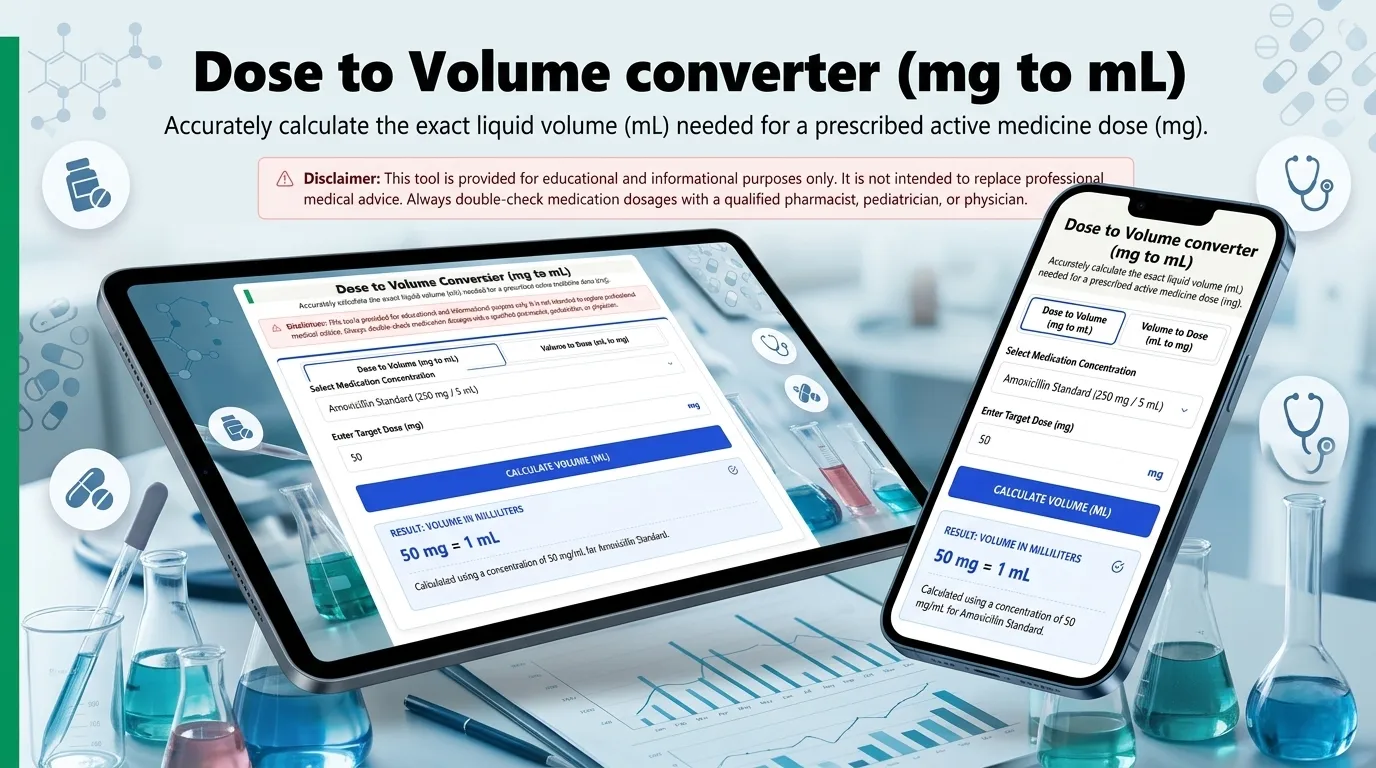
Manual math can be stressful, especially when caring for a sick family member in the middle of the night. A dedicated calculator tool removes human error and provides instant, accurate results. By simply inputting the medicine’s strength from the bottle and the amount of liquid you plan to administer into our tool above, you can instantly bridge the gap between liquid volume and active dosage.
Examples of mL to mg Conversion
Let’s look at a real-world scenario to make the math clearer.
Imagine your doctor prescribes an antibiotic and tells you to give your child a 150 mg dose. You pick up the liquid from the pharmacy, and the bottle says the strength is 250 mg per 5 mL.
First, divide 250 by 5. This tells you there are 50 mg of medicine in every single milliliter. Since you need to reach a total of 150 mg, you divide your target (150) by the per-mL strength (50). The answer is 3. You need to measure out exactly 3 mL of liquid to deliver the proper dose.
Common Liquid Medicine Conversions
Certain over-the-counter remedies are staples in most household medicine cabinets. While you should always read your specific bottle, these standard formulations are very common:
- Children’s Pain Relievers: Often formulated at 160 mg per 5 mL. This means every 1 mL contains 32 mg of active relief.
- Infant Drops: These are typically much stronger so babies don’t have to swallow a lot of liquid. A common strength is 50 mg per 1.25 mL, meaning every 1 mL holds a concentrated 40 mg of medicine.
- Allergy Syrups: Usually formulated at a lower strength, such as 12.5 mg per 5 mL, yielding 2.5 mg of active ingredient per individual milliliter.
mL to mg Conversion Chart
Here is a quick reference guide showing how much active medicine is in a single milliliter for some of the most common pharmaceutical strengths.
| If the Bottle Label Says… | Then 1 mL of Liquid Contains… |
|---|---|
| 5 mg / 5 mL | 1 mg |
| 12.5 mg / 5 mL | 2.5 mg |
| 100 mg / 5 mL | 20 mg |
| 160 mg / 5 mL | 32 mg |
| 50 mg / 1.25 mL | 40 mg |
| 250 mg / 5 mL | 50 mg |
| 400 mg / 5 mL | 80 mg |
Understanding mg per mL (Concentration)
Concentration is the “secret code” to understanding liquid medication. It simply describes how tightly packed the active drug molecules are within the sugary syrup or flavored water.
In pharmacology, measuring the exact concentration ensures you know exactly how strong your liquid mixture is before you measure it out.
Why Concentration Matters in Dosage
Overlooking the strength listed on a bottle is one of the leading causes of accidental dosing errors. Drug manufacturers often produce different versions of the same medicine for different age groups.
For instance, you might have an infant version and a children’s version of the same fever reducer. The infant version is highly concentrated so a baby only needs to swallow a tiny squirt. If you mistakenly give a toddler the same volume of the infant drops as you normally would the children’s syrup, you could accidentally deliver a massive overdose. Always verify the strength before calculating.
Liquid Dosage Guide (mL to mg)
To ensure maximum safety when handling liquid prescriptions, follow these best practices:
- Always read the front label: The strength is usually printed in bold letters right under the brand name.
- Shake well: Active ingredients can settle at the bottom of the bottle. Shaking ensures the concentration is perfectly even throughout the liquid.
- Use the right tool: Always use the oral syringe or marked dosing cup that came with the packaging to measure your volume.
Mistakes to Avoid in Volume Conversion
- Using Kitchen Spoons: A culinary teaspoon is not standardized. Some hold 3 mL, while others hold 7 mL. Never use silverware to measure medication.
- Assuming a 1:1 Ratio: Water is the only liquid where 1 milliliter naturally equals 1 gram. Medicine is a mixture, so 1 mL never automatically equals 1 mg.
- Relying on Old Habits: If your pharmacy switches to a different generic brand, the new bottle might have a completely different concentration than the one you are used to. Always read the new label.
When to Use mL to mg Conversion
You will find this math helpful in several common scenarios:
- When a pediatrician tells you a dose over the phone based on your child’s weight (which they will state in milligrams), but you only have a syringe marked in milliliters.
- When you are tracking your daily intake of a specific supplement or vitamin and need to log the exact active amount you consumed.
- When you are verifying a pharmacy label to ensure the physical liquid amount they told you to give matches the doctor’s original prescription.
Volume vs Dose: Key Differences
To summarize the core concept, keep these two definitions in mind:
- Volume is the “vehicle.” It is the physical space the liquid takes up, measured in milliliters (mL). It is what you look at in the syringe.
- Dose is the “passenger.” It is the mass or weight of the actual drug riding inside that vehicle, measured in milligrams (mg). It is what your body actually absorbs and uses to heal.
FAQs on Volume to Dose Conversion
Is 1 milliliter equal to 1 milligram?
No. While they sound similar, they measure different things. The amount of milligrams inside a single milliliter changes depending entirely on how the drug manufacturer mixed the medicine.
Can I use water to figure out the conversion?
No. The density of pure water has a 1-to-1 ratio with grams, but liquid medicine is a complex mixture of water, active drugs, flavorings, and stabilizers. You must use the concentration printed on the specific bottle.
Where do I find the concentration of my medicine?
It is almost always printed on the front label of the bottle or box, typically right beneath the main product name. It will usually be displayed as a fraction, such as “200 mg / 5 mL”.
Authoritative Sources & Clinical References
The information and math logic utilized in this calculator align with standard clinical pharmacology practices outlined by the following health organizations: