Solar⇄Lunar Calendar Converter
Astro-Calendar Analysis
Instant Solar and Lunar Date Converter (Two-Way Tool)
For centuries, humanity has looked to both the sun and the moon to track time. While the modern world primarily uses the Solar (Gregorian) calendar for business and daily life, the Lunar calendar remains the heartbeat of cultural traditions, festivals, and agricultural timing across Asia and the Middle East.
Use our Solar⇄Lunar Calendar Converter to easily convert Lunar dates to Solar and Solar dates to Lunar. Fast, accurate, and completely free online tool.
Understanding the Two Systems (Solar & Lunar)
To appreciate how the converter works, it helps to understand the fundamental difference between the two methods of timekeeping:
- The Solar Calendar: Based on the Earth’s orbit around the sun ($approx. 365.24$ days). It is designed to keep the seasons in the same place every year.
- The Lunar Calendar: Based on the monthly phases of the moon ($approx. 29.53$ days per month). A pure lunar year is about 11 days shorter than a solar year.
- The Luni-Solar Balance: To prevent the calendars from drifting apart, many traditional systems (like the Chinese Lunar calendar) add a Leap Month (Intercalary month) roughly every three years to “catch up” to the sun.
How to Use the Solar⇄Lunar Calendar Converter
The tool is designed to be intuitive, whether you are a historian, a gardener, or someone planning a traditional wedding. Here is the step-by-step guide:
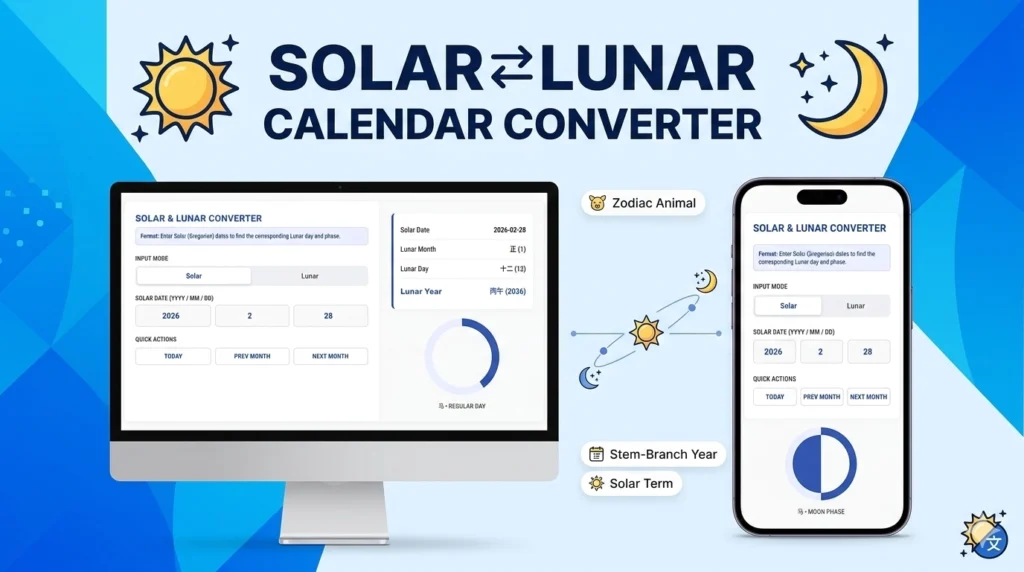
Step 1: Select Your Input Mode
At the top of the calculator, use the Pill Toggle to choose your starting point:
- Solar: Use this if you have a modern date (e.g., your birthday or a future event) and want to find the Lunar equivalent.
- Lunar: Use this if you have a traditional date (e.g., “The 15th day of the 8th Lunar Month”) and need to find when it occurs on the modern calendar.
Step 2: Enter the Date
Input the Year, Month, and Day into the numeric fields.
- Note for Lunar Mode: If the specific year contains a “Leap Month,” you can check the Leap Month box to ensure the conversion stays accurate to the traditional intercalary cycle.
Step 3: Use Quick Actions
- Today: Click this to instantly reset the calculator to the current date and moon phase.
- Prev/Next Month: Use these to quickly cycle through months without manually typing the numbers.
Step 4: Analyze the Results
The Output Side (right column) will immediately update:
- Solar/Lunar Date: Displays the converted date.
- Month/Day Labels: Shows both the English numeral (e.g., Month 1) and the traditional name.
- Moon Phase Chart: A visual doughnut chart shows how far the moon is into its current cycle.
Step 5: Explore Detailed Analysis
Click the Show Detailed Analysis button to reveal a deeper breakdown. This section includes the Zodiac Animal, Heavenly Stems/Earthly Branches, and the specific Solar Term (Jie Qi), providing a full astronomical profile of that specific day.
Key Features & Benefits
- Bi-Directional Conversion: Seamlessly switch between Gregorian and Lunar formats.
- Cultural Accuracy: Built-in logic for leap months and GanZhi cycles.
- Visual Feedback: The moon phase chart helps you visualize the night sky for the selected date.
- Mobile Friendly: Optimized for use on both desktop and smartphones.
Why Use a Solar-Lunar Converter?
- Cultural Festivals: Determine the exact modern date for Lunar New Year or the Mid-Autumn Festival.
- Ancestral Traditions: Convert traditional dates found in family records into the Gregorian format.
- Agriculture: Many gardeners use lunar cycles to determine the best times for planting and harvesting.
- Personal Insight: For those interested in traditional horoscopes, knowing your precise GanZhi pillars is essential.
Would you like me to generate a Lunar Calendar reference table for 2026 showing the dates for the major traditional festivals?
Related