mL to mg Conversion
Accurately convert volume (milliliters) to mass (milligrams).
How to Convert Milliliters to Milligrams
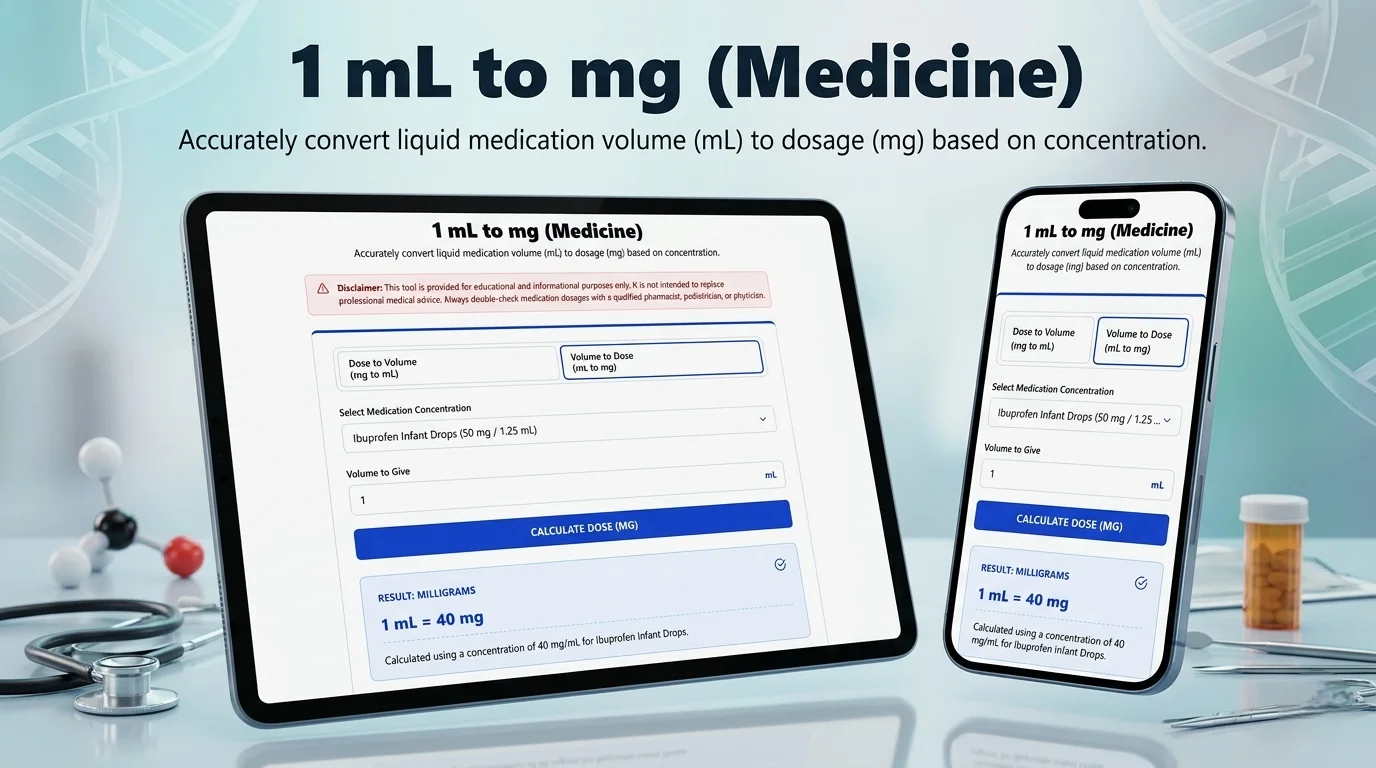
Because milliliters are a unit of volume (space) and milligrams are a unit of mass (weight), they measure entirely different physical quantities. To convert between them, you must know an additional property of the substance: its density.
Density dictates how tightly packed the mass is within a given volume. Therefore, to convert milliliters to milligrams, you must multiply by the substance’s density, and to convert milligrams to milliliters, you divide.
Milliliters to Milligrams Formula
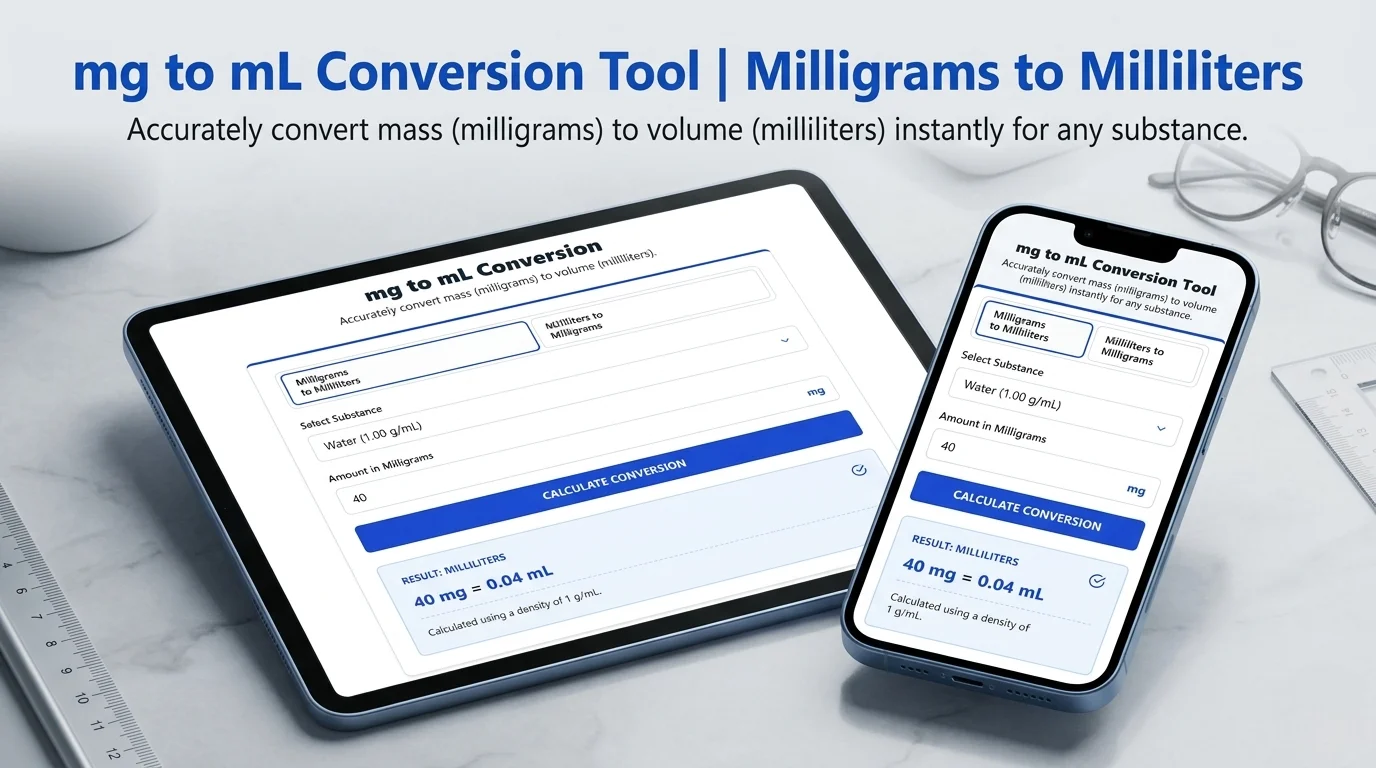
To convert a measurement in milliliters to milligrams, you multiply the volume by the density of the ingredient, and then multiply by 1,000. Note that the density must be in grams per milliliter (g/mL).
Conversely, if you need to calculate volume from mass, you use the inverse formula. The mass in milligrams is divided by the density multiplied by 1,000.
Example Calculation: If you have 15 milliliters of an ingredient with a known density of 0.85 g/mL (like granulated sugar), you calculate the mass by multiplying 15 by 0.85 by 1000. The result is exactly 12,750 mg.
How Many Milligrams Are in a Milliliter?
The table below provides pre-calculated mass conversions (in mg) for common kitchen ingredients based on varying milliliter volumes.
| Volume (mL) | Water (1.00 g/mL) |
Milk (1.03 g/mL) |
Cooking Oil (0.92 g/mL) |
AP Flour (0.53 g/mL) |
Sugar (0.85 g/mL) |
|---|---|---|---|---|---|
| 1 mL | 1,000 mg | 1,030 mg | 920 mg | 530 mg | 850 mg |
| 5 mL | 5,000 mg | 5,150 mg | 4,600 mg | 2,650 mg | 4,250 mg |
| 10 mL | 10,000 mg | 10,300 mg | 9,200 mg | 5,300 mg | 8,500 mg |
| 15 mL | 15,000 mg | 15,450 mg | 13,800 mg | 7,950 mg | 12,750 mg |
| 30 mL | 30,000 mg | 30,900 mg | 27,600 mg | 15,900 mg | 25,500 mg |
| 50 mL | 50,000 mg | 51,500 mg | 46,000 mg | 26,500 mg | 42,500 mg |
| 100 mL | 100,000 mg | 103,000 mg | 92,000 mg | 53,000 mg | 85,000 mg |
When to Convert Milliliters to Milligrams ?
Milliliters and milligrams are heavily utilized in cooking, baking, and pharmacology.
For culinary applications, professional chefs highly recommend measuring dry ingredients by mass (weight) rather than volume to ensure strict accuracy. The density of dry ingredients fluctuates drastically based on compaction, sifting, and clumping. However, when a kitchen scale is unavailable, converting weights to volume using average densities is a highly practical workaround.
In the fields of chemistry and medicine, conversions are vital. When combining distinct chemicals or synthesizing pharmaceuticals, exact mass-to-volume ratios are required to ensure safe dosages and maximize the yield of a reaction.
What is a Milliliter (mL)?
A milliliter is a metric unit of volume equivalent to 1 cubic centimeter (cm³), 1/1,000 of a liter, or roughly 0.061 cubic inches.
It utilizes the SI metric prefix “milli”. Because one milliliter takes up exactly one cubic centimeter of space, the terms mL and cc are frequently used interchangeably in medical and engineering contexts.
What is a Milligram (mg)?
A milligram is a unit of mass equal to 1/1,000 of a gram, or approximately 0.0154 grains.
The milligram (or milligramme) is an official SI unit of mass within the metric system. In the metric nomenclature, the prefix “milli” designates a factor of one thousandth (10-3). While technically a measure of mass, it is colloquially referred to as a unit of weight.
References
- National Institute of Standards & Technology, Culinary Measurement Tips
- CK-12 Foundation, Introductory Chemistry: Mass-Volume Stoichiometry
- NIST, Technical Requirements for Weighing and Measuring Devices